
In contemporary lighting design, the light source has a direct impact on the final outcome. Not just in terms of efficiency, but also in the perceptual quality of the light, how it can be controlled, and how it relates to the architecture.
Today, using LED is no longer a question of if, but how. In this context, SOB and SMD technologies represent two different approaches to the light source, each with specific implications for the project.
Understanding the difference between SOB and SMD is not just about choosing the right product—it means shaping the result: visual rendering, beam control, colour flexibility, and project integration.
LED: a shared foundation, two different approaches
Both SOB and SMD are based on the same core technology: the LED, a semiconductor device that emits light when electrical current passes through it. The difference does not lie in the physical principle, but in how the LED chips are arranged and used.
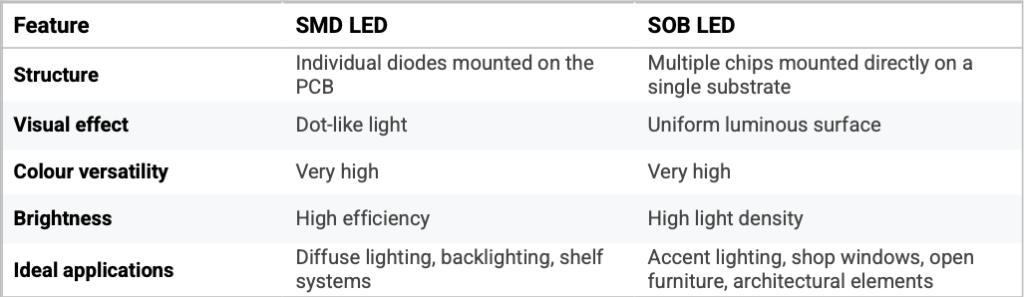
SMD LEDs (Surface Mounted Device) are individual diodes mounted on a printed circuit board (PCB). Each chip works independently and is visible as a light point.
SOB LEDs (Silicon On Board), on the other hand, group multiple chips directly onto a single substrate, forming a continuous luminous surface that appears as a single light source, offers better colour uniformity, and ensures greater mechanical strength and flexibility.
Source structure and design implications
From a construction perspective, SMD uses separated chips spaced apart. This makes the source highly modular, lightweight, and easy to integrate into slim profiles or flexible systems. It’s a solution that prioritises versatility.
SOB, instead, uses tightly packed chips mounted on a single base, all covered by a uniform layer of silicone. Electrically, this usually means just one circuit and two contacts, regardless of how many diodes are present. The result is a compact, powerful source that is easy to manage in luminaire design.
Light quality and visual effect
This is where the difference between SOB and SMD becomes immediately visible, especially to designers and architects.
SMD sources can produce a dotted or pixelated effect, especially when the source is exposed or inserted into linear profiles without proper diffusers. This effect can be softened with opal covers or frosted finishes, but it remains an intrinsic feature of the technology.
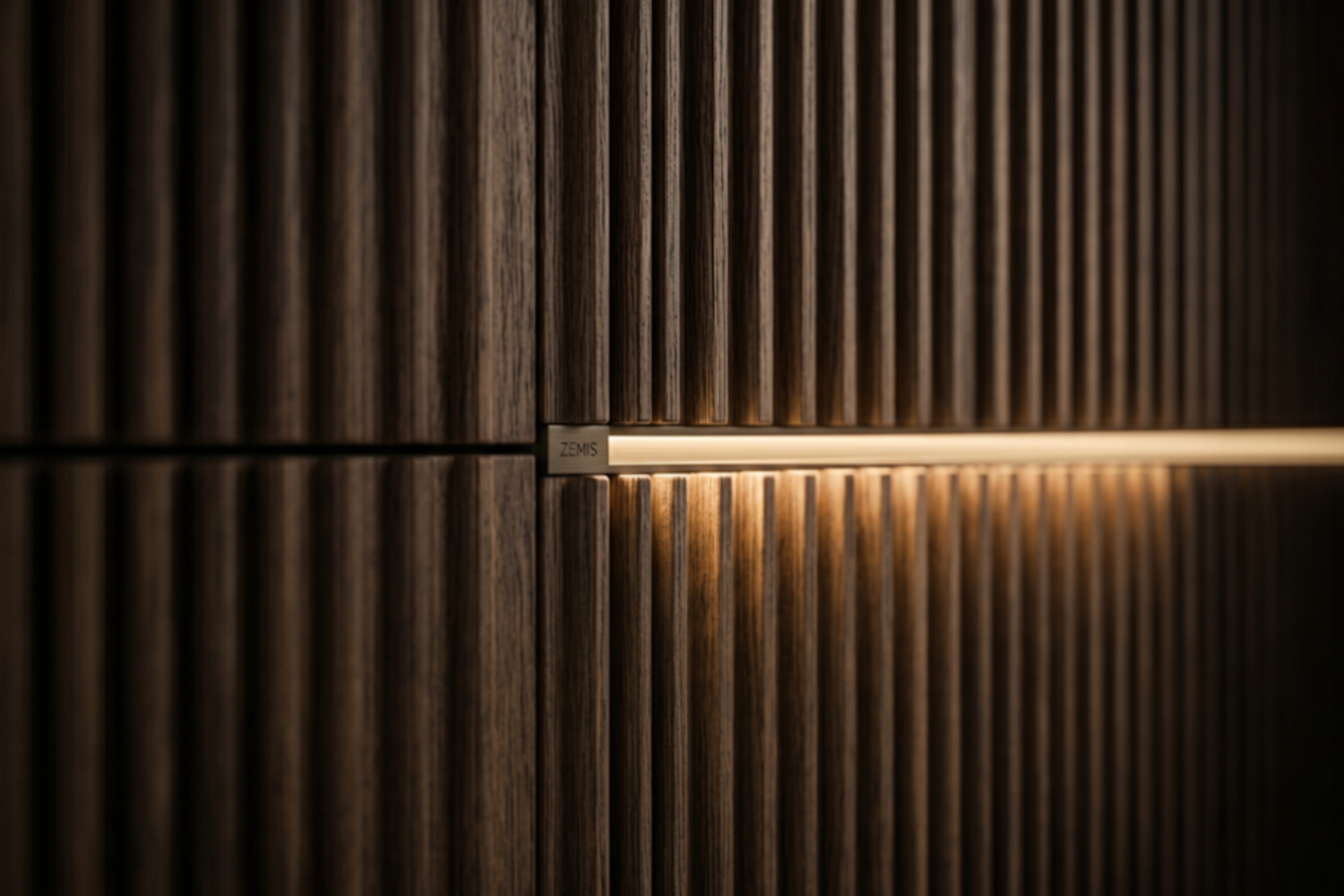
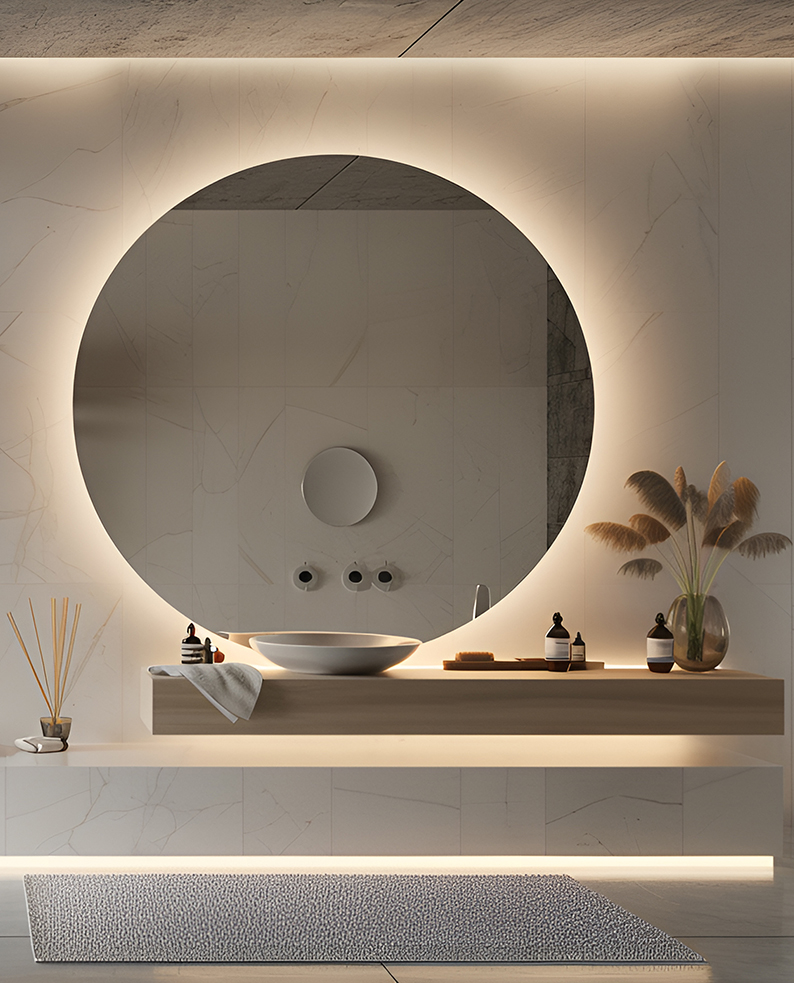
SOB LEDs, by contrast, emit a continuous and uniform light, free from visible points. For this reason, they are often the preferred choice in contexts where the source is integrated into the architecture or left exposed: cove lighting, visible profiles, spotlights, accent lights. The even luminous surface reduces glare and delivers a cleaner, more controlled result.

Colour, control and chromatic flexibility
When the project requires colour dynamism, SMD technology offers a clear advantage. The integration of multiple coloured diodes within the same package enables RGB, RGBW, and Tunable White solutions, ideal for variable lighting scenes and colour temperature adjustment over time.
Efficiency, power consumption and thermal management
Both technologies are efficient, but with different characteristics. SOB often delivers higher lumens per watt and can exceed 80 lm/W, making it particularly effective when high light output is needed in a compact format. This density, however, calls for careful thermal management, requiring appropriate heatsinks.
SMD distributes heat across a larger PCB surface, simplifying cooling and increasing overall reliability. Moreover, if one chip fails, the rest of the source keeps working—an important factor in large applications such as strips and panels.
Strategic applications in design
The question “SOB or SMD?” has no absolute answer. As always, it depends on the context and specific application.
SMD LEDs are ideal for diffuse lighting, light panels, signage, and decorative solutions, as well as for applications where colour flexibility or modularity is key. They are often used in shelf lighting, backlighting, and integrated systems where light supports the product without dominating.
SOB LEDs are the preferred option for accent lighting, spotlights, light paths, and in all situations where the source is visible or architecturally integrated and visual performance must be impeccable. Storefront displays, furniture interiors, niches, and open profiles require a continuous, uniform, dot-free light capable of enhancing both materials and objects.

Main differences at a glance:
Choosing the source means making a design decision
SOB and SMD are not competing alternatives, but different tools available to the designer. SMD offers efficiency and chromatic flexibility; SOB provides better visual quality and beam control, making it ideal in many architectural settings.
Real expertise lies in reading the data, including SPD (Spectral Power Distribution), and understanding how light interacts with materials, surfaces and spatial volumes. Because, once again, light is not something you simply add. It’s something you design.